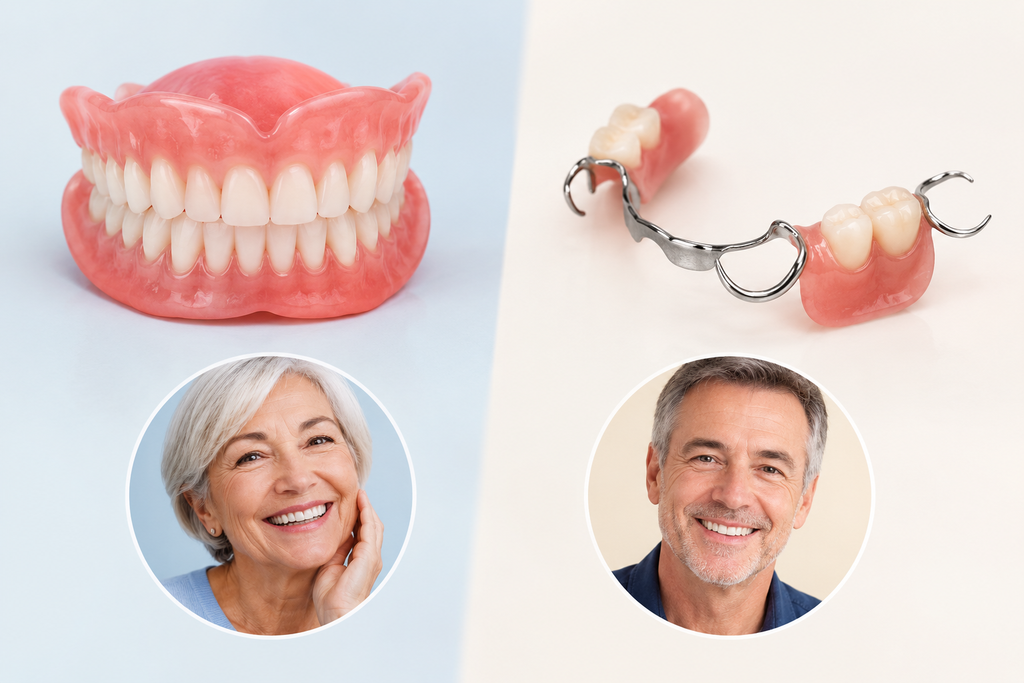
Restoring your smile after tooth loss does far more than just improve aesthetics—it restores your ability to chew comfortably, speak clearly, and feel confident in daily interactions. If you are exploring tooth replacement options, you have likely come across both complete dentures and partial dentures.
Understanding the key differences between these options helps you make an informed decision when consulting with your dentist.
What Are Dentures?
Dentures are custom-crafted prosthetic devices designed to replace missing teeth and surrounding gum tissue. Modern dental technology ensures that today’s dentures look highly natural, matching the shade, shape, and appearance of your natural teeth and gums.
Beyond improving your smile, dentures provide critical structural support to your lips and cheek muscles, preventing the facial sagging that often accompanies tooth loss.
What Are Complete Dentures?
Complete dentures (commonly referred to as full dentures) are designed for individuals who have lost all of their natural teeth in either the upper jaw, lower jaw, or both.
- Design: They consist of a full arch of artificial teeth set into a gum-colored acrylic base that sits directly over your gums.
- When They Are Used: They are recommended when no natural teeth remain, or when remaining teeth are severely decayed, loose, or damaged beyond repair and require extraction.
- Benefits: Full dentures restore essential oral functions, including chewing and speech articulation, while fully renewing facial structure and aesthetics.
What Are Partial Dentures?
Partial dentures are ideal for individuals who are missing several teeth but still retain healthy, natural teeth in the upper or lower jaw.
- Design: A partial denture fills in the specific gaps left by missing teeth. It typically attaches to adjacent natural teeth using subtle metal or tooth-colored clasps.
- When They Are Used: Recommended when you have one or more strong, healthy natural teeth remaining.
- Benefits: They allow you to preserve your healthy natural teeth while preventing adjacent teeth from shifting out of position into empty spaces.
Complete Dentures vs. Partial Dentures: Key Differences
The primary distinction between the two rests on how many natural teeth remain:
- Extent of Replacement: Complete dentures replace an entire arch of missing teeth, whereas partial dentures fill isolated gaps across an arch.
- Support System: Complete dentures rely on suction, precise fitting, and natural mouth anatomy (or minor dental adhesives) to stay in place. Partial dentures leverage the strength of remaining healthy natural teeth for anchorage and stability.
- Tooth Preservation: Partial dentures prioritize saving healthy teeth, which maintains natural jawbone structure around those root systems.
Adapting to Life with Dentures
- Comfort & Fit: It is normal to undergo an adjustment period lasting a few weeks. Your tongue and cheek muscles need time to adapt to holding the appliance in place. A properly fitted denture should not causeAlternative Solutions for Missing Teeth
- persistent pain or sore spots; minor dental adjustments can easily resolve initial discomfort.
- Eating & Diet: Start with soft foods cut into small bites. Chew evenly on both sides of your mouth to balance pressure. Over time, you can gradually reintroduce firmer foods into your diet.
- Longevity & Care: Dentures typically last several years, but because your gums and jawbone structure naturally change over time, they will eventually require relining, adjustments, or replacement. Clean your dentures daily with non-abrasive cleaners, avoid hot water (which warps the base), and keep remaining natural teeth and gums thoroughly brushed.
Proper cleaning and regular care are essential for maintaining dentures and oral health. The American Dental Association’s guide to denture care provides useful information on cleaning, storage, fit, and maintenance.
Alternative Solutions for Missing Teeth
While dentures are a proven, cost-effective solution for widespread tooth loss, they are not the only treatment available. Depending on your oral health, jawbone density, and personal goals, your dentist may also evaluate:
Dental crowns are commonly used when a tooth is weakened, cracked, heavily damaged, or has undergone root canal treatment. A crown covers the damaged tooth and helps restore its strength, shape, and appearance. If you are wondering when you need dental crowns or bridges, a dental consultation can help determine whether either option is suitable for your specific condition.
- Dental Bridges: Fixed prosthetics suitable for filling gaps of one to three missing teeth in a row.
- Dental Implants: Permanently anchored titanium posts that support individual crowns, bridges, or implant-supported overdentures for maximum stability.
Choosing the Right Option
Determining whether complete or partial dentures are right for you requires a comprehensive clinical examination, including evaluations of your jawbone health, bite alignment, and remaining tooth stability. If preserve-worthy natural teeth remain, keeping them is often a primary goal in your treatment plan.
If you are considering dentures, you can also explore our Dentures and Prosthesis treatment options to understand how missing teeth can be restored.
Consulting with a dentist will allow you to explore custom options tailored specifically to your oral health, budget, and lifestyle needs.