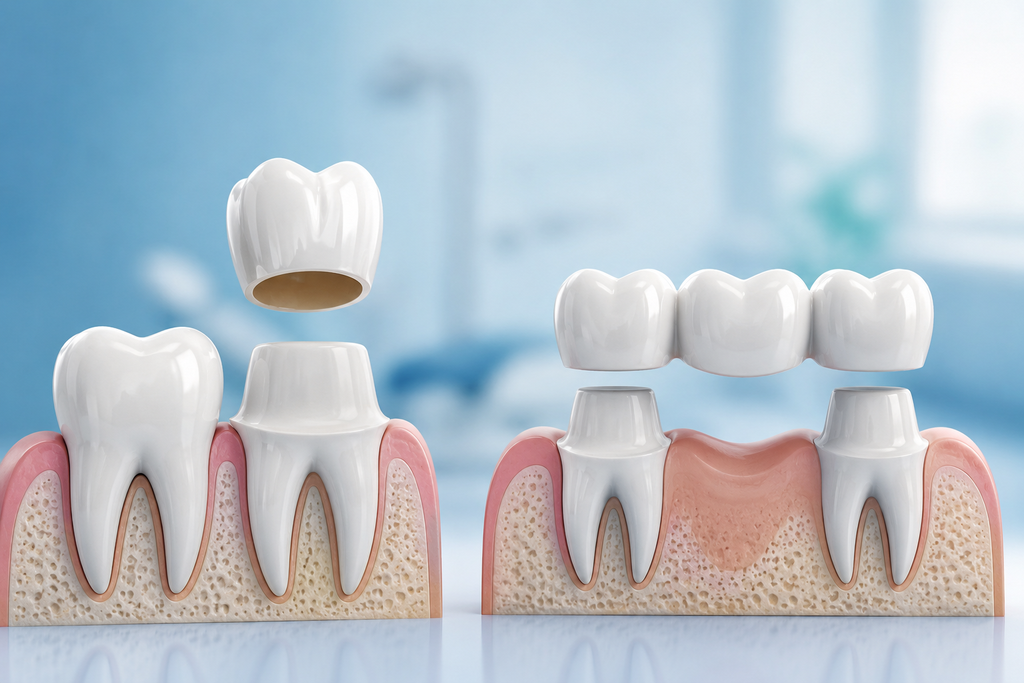
Biting down and feeling a sudden crack—or living with a gap from a missing tooth—can make everyday tasks like eating and speaking frustrating. When you visit the dentist for these issues, you will likely hear them mention crowns or bridges.
While both options restore your smile, they serve very different purposes depending on the condition of your remaining teeth, the size of any gaps, your bite, and your overall oral health.
Understanding Dental Crowns
A dental crown is a custom-made cap designed to fit over a single damaged or weakened natural tooth. It restores the tooth’s natural shape, strength, and appearance. Think of a crown as an outer shield: rather than extracting a tooth that still has strong roots, a crown preserves and protects what remains of the natural structure.
A dentist may recommend a crown in the following situations:
- Large Fillings: A tooth has a massive filling with very little natural structure left to support it.
- Severe Damage: A tooth is badly cracked, broken, or heavily decayed beyond what a standard filling can fix.
- Post-Procedure Support: A tooth needs extra protection after undergoing a root canal.
- Dental Implants: A crown acts as the visible top portion of an individual dental implant.
- Cosmetic Restoration: A tooth is severely discolored or misshapen and requires full coverage for an improved appearance.
Understanding Dental Bridges
While a crown protects an existing tooth, a dental bridge is designed to fill a gap left by one or more missing teeth.
Imagine missing a tooth between two healthy ones. A dental bridge anchors to the natural teeth (or implants) on either side of the space and holds a pontic—a realistic artificial tooth—in the middle to “bridge” the empty gap.
Crown vs. Bridge: Which One Do You Need?
The simplest way to break down the difference comes down to saving a tooth versus replacing one:
- Crown: Restores and covers an existing, damaged tooth.
- Bridge: Replaces one or more entirely missing teeth.
If you have a molar that is severely cracked but still securely rooted, your dentist will likely suggest a crown. If that molar is already gone and leaves an open gap between two healthy teeth, a bridge is often the recommended solution.
Why You Shouldn’t Ignore a Missing Tooth
Because a missing tooth isn’t always painful, it can be tempting to just live with the space. However, leaving a gap open can cause long-term complications:
- Nearby teeth may gradually shift into the open space, throwing off your bite alignment.
- Chewing and speaking can become awkward or uncomfortable over time.
- The jawbone beneath the missing tooth can slowly deteriorate without active root stimulation.
Having a gap evaluated early can be helpful, as missing teeth may affect chewing, speaking, and the position of surrounding teeth.
What to Expect During Your Evaluation
Before deciding on a treatment plan, your dentist will perform a thorough assessment to check:
- The structural strength of your remaining teeth and existing fillings.
- The health of your gums, bite alignment, and surrounding bone density.
- X-rays and diagnostic tests to look for hidden decay or underlying infection.
- Gum health is also an important part of protecting your teeth and supporting dental restorations. If you want to understand how gum health can affect more than just your mouth, learn more about gum disease and your overall health.
This evaluation ensures you receive the treatment that best protects your long-term oral health.
Caring for Your Restorations
Crowns and bridges are built to be long-lasting and durable, but they still require daily maintenance. Plaque can build up around the edges of a restoration—especially along the gumline and underneath a bridge.
To keep your restoration intact:
- Brush twice daily with fluoride toothpaste.
- Clean between your teeth daily using floss, interdental brushes, or a water flosser.
- Keep up with regular dental checkups and professional cleanings.
Overcoming Dental Anxiety
It is completely natural to feel anxious when discussing dental procedures. If you feel nervous, let your dental team know beforehand. Modern Dentistry offers gentle pain management techniques and options to help keep you comfortable and relaxed throughout your visit.
Protect Your Smile Early
A minor chip, a broken tooth, or an empty gap might seem manageable right now, but delaying care can lead to more complex treatments down the road. Schedule a consultation with your dentist to discuss your options and take the first step toward a strong, healthy smile.